Remember when we all thought ChatGPT was a miracle because it could write a poem or debug a line of code? You
typed a prompt, waited a couple of seconds, and got an answer. It was magic, but it was passive. You were
still the driver, the supervisor, and the glue holding the workflow together.
Fast forward to 2026, and the tech landscape has shifted entirely. We have officially entered the era of
Agentic AI.
Let’s Start With a Real-World Example
Imagine you ask a colleague to book a flight for a business trip to Dubai. A helpful but passive colleague
would sit at their desk, wait for you to give them every detail, draft an itinerary, slide it across the
table, and then wait for you to do the actual booking.
Now imagine a different kind of colleague. One who hears the goal, figures out the details independently,
searches multiple flight options, cross-checks your existing calendar for conflicts, books the best option
within your budget, emails you a confirmation, adds it to your calendar, and notifies your team, all while
you are in a meeting doing something else entirely.
That second colleague is not a human. That is agentic AI. And in 2026, it is not a concept in a research
paper anymore. It is sitting inside business systems, hospital workflows, e-commerce platforms, and software
development pipelines, doing exactly that kind of autonomous, multi-step work every single day.
This guide explains what agentic AI actually is, how it works under the hood, why it is fundamentally
different from every other form of AI that came before it, and most importantly, how it is changing the real
world right now.
What Is Agentic AI?
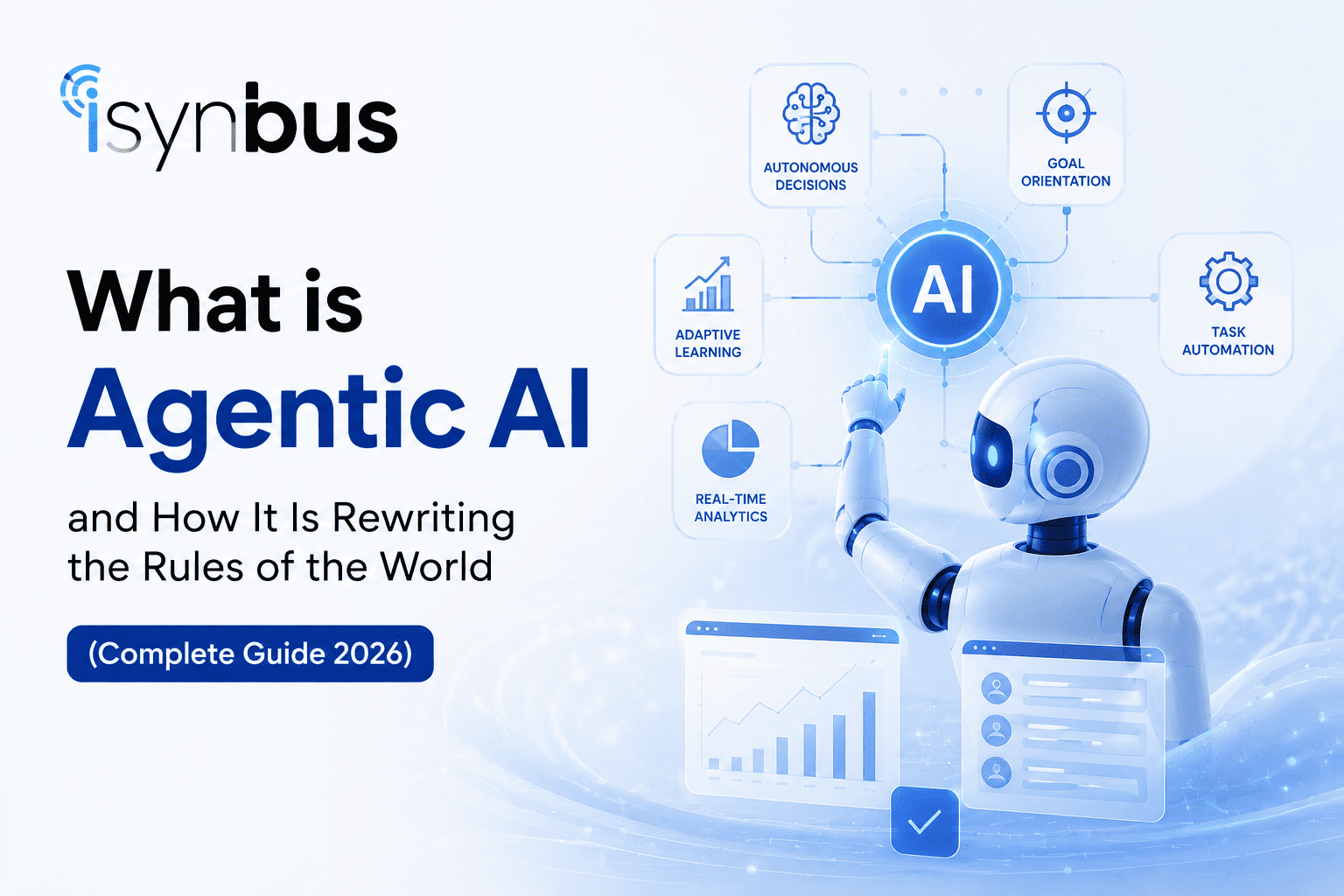
Agentic AI
refers to artificial intelligence systems that can set goals, make decisions, take sequences of
actions, use external tools, and adapt their approach based on results, all with minimal or zero human
intervention at each step.
The word “agentic” comes from “agency” — the capacity to act independently in the world. And that word
captures the essential difference between agentic AI and everything that came before it.
Most AI tools you have used, including the large language models (LLMs) that became mainstream after 2022,
are fundamentally reactive. You give them a prompt. They give you an output. The conversation ends. They
have no memory of what they just told you beyond the current session. They cannot go out into the world and
do something on your behalf. They cannot learn from what just happened and adjust their future behaviour.
They wait.
Agentic AI does not wait. It acts.
Generative AI creates content — text, images, and summaries. Agentic AI takes it a step further by
thinking, acting, making decisions, and completing tasks autonomously.
That distinction sounds simple. Its implications are anything but.
Looking to build Agentic AI into your business?
Our team at Isynbus specializes in Agentic AI systems, workflow automation, and intelligent digital
solutions for businesses of all sizes.
Agentic AI combines several advanced technologies, including:
1. Large Language Models (LLMs)
These models understand and generate human-like language.
2. Memory Systems
Agentic AI remembers previous interactions and context.
3. Planning Engines
The AI can break large goals into smaller tasks.
4. Tool Integration
It can connect with apps, APIs, websites, databases,
CRMs
, and business tools.
5. Autonomous Decision-Making
The AI decides what action to take next based on goals and real-time information.
Together, these technologies create AI systems that behave more like intelligent digital employees rather
than simple assistants.
Difference Between Traditional AI and Agentic AI
Traditional AI
Agentic AI
Responds to commands
Takes initiative
Works on single tasks
Handles multi-step workflows
Limited memory
Long-term contextual memory
Human-dependent
Semi-autonomous
Static responses
Adaptive decision-making
This is why businesses worldwide are rapidly investing in Agentic AI solutions in 2026.
The Difference Between Generative AI vs Agentic AI
The confusion between these two terms is understandable because agentic AI systems often use generative AI as
one of their components. But they are not the same thing, and treating them as interchangeable leads to a
fundamentally distorted view of what is coming.
Here is a concrete example that makes the distinction unmistakable.
A sales manager wants to follow up with a list of 50 leads who attended a webinar last week.
With generative AI, she opens ChatGPT or Claude, types a prompt asking for a follow-up email template,
receives a well-written draft, copies it, pastes it 50 times into her email platform, personalises each one
manually, and hits send.
With agentic AI, the system identifies high-intent leads from CRM data, launches personalised outreach
emails, replies to follow-ups, and even books demos, all with no human intervention.
Same goal. Completely different experience. The first requires the human to do the work with AI as an
assistant. The second has the AI do the work while the human focuses on something more valuable.
Generative AI generates content (text, images, videos) reactively in response to prompts. Agentic AI
autonomously manages multi-step workflows, maintains memory across steps, and calls external tools to
complete tasks with minimal human intervention. Governance requirements also diverge sharply: generative AI
poses informational risk through hallucinations and bias, while agentic AI introduces operational risk
through autonomous actions on live systems.
Why 2026 Is the Turning Point
The reason Agentic AI matters so much in 2026 is that the technology has finally become operationally
practical. For years, autonomous AI systems existed mostly in research labs and experimental prototypes. Now
the ecosystem is mature enough for real-world deployment.
AI models are more capable
Infrastructure is more scalable
Enterprise APIs are standardized
Cloud systems are AI-ready
Businesses are generating enough data for intelligent automation to work
effectively
Everything is converging at the same time.
And whenever that happens in technology, industries change very quickly.
Agentic AI is likely the next major shift in that sequence.
Transform Your Business with Agentic AI
Join 200+ global brands who trust Isynbus for their most critical software engineering and AI
implementation challenges. Let’s build something extraordinary.
How Does Agentic AI Actually Work? The Four Building Blocks
Understanding what makes agentic AI tick is not just intellectually interesting; it is practically important
if you are thinking about adopting it in a business context. Strip away the marketing language, and every
agentic AI system is built from four core capabilities.
Perception: Reading the Environment
Before an AI agent can act, it needs to understand the context it is operating in. This includes
reading data from APIs, databases, documents, emails, calendar entries, websites, sensor feeds, or
any other information source relevant to its goal. A sophisticated agentic system does not just read
a single input — it synthesises information from multiple sources simultaneously to build a
coherent picture of the situation.
Planning: Breaking Goals Into Steps
This is where agentic AI genuinely diverges from what came before. When you give an agentic system a
goal, it does not just respond to that instruction. It decomposes it into a sequence of sub-tasks,
decides what order to tackle them in, identifies which tools or systems it needs to access, and
builds an execution plan. This multi-step reasoning capability is what makes genuinely complex
autonomous work possible.
Action: Using Tools and Systems
An agentic AI agent does not just think. It acts. It sends emails. It searches the web. It writes
code and runs it. It queries databases. It calls APIs. It fills out forms. It books meetings. The
range of actions available to a given agent depends on what tools it has been connected to, but the
principle is the same: the agent does not just describe what should be done. It does it.
Memory and Learning: Getting Better Over Time
Unlike conventional sessions with a generative AI system, where each new session begins afresh,
agents have the capacity to retain their memories throughout sessions. Short-term memory enables the
agent to retain the context of the current task. Long-term memory allows the agent to learn through
past sessions, know what has been effective, and become better at its work.
Industries Where Agentic AI Is Changing the World
Theory is one thing. The real story of agentic AI in 2026 is being written in hospitals, banks, logistics
hubs, software development teams, and customer service centres. Here is what that looks like on the ground.
Healthcare: From Reactive to Predictive
The healthcare industry already has a 68% usage rate of AI agents. AI applications in healthcare can generate
up to $150 billion in annual savings for the industry by 2026. In practice, this means agentic systems that
monitor patient vitals continuously, flag deterioration patterns before they become crises, automatically
adjust medication reminders, coordinate between specialist departments, and handle the administrative burden
of appointment scheduling, insurance verification, and medical record retrieval — all without pulling
a single doctor or nurse away from patient care.
Banking and Finance: Speed and Accuracy at a Scale Humans Cannot Match
Banks implementing agentic AI for KYC and AML workflows are realising 200% to 2,000% productivity gains.That
is not a typo. A
process that required a team of compliance analysts working through stacks of documentation can now be
handled by an agent that reads, cross-references, flags anomalies, and generates compliance reports
autonomously. An agentic AI system in a finance context gathers transactional data, reconciles
discrepancies, submits filings, and generates comprehensive reports — what used to be weeks of manual
work compressed into hours.
Software Development: The Agent That Writes, Tests, and Fixes Its Own Code
By 2028, 75% of software developers are expected to use AI coding agents, up from less than 10% in 2023.
Agentic coding tools in 2026 do not just autocomplete lines of code. They take a product requirement, write
the implementation, run the tests, identify failures, debug the issues, refactor the solution, and push a
working version — often within the time it would take a developer to read the ticket.
Customer Service: From Scripted Chatbots to Genuinely Helpful Agents
Around 80% of customer service teams will adopt AI by 2026 to improve productivity. The agentic customer
service systems of 2026 are not the frustrating chatbots of 2022 that could only answer five questions
before escalating everything to a human. They access order histories, check inventory, process refunds,
rebook deliveries, update account details, and resolve complex multi-step complaints end to end while
simultaneously handling thousands of other customer conversations.
E-Commerce and Commerce: Buying Agents Are Already Here
Around 70% of consumers use AI agents for travel bookings, while 65% rely on them for hotel reservations. For
shopping, 59% use AI for electronics, 56% for beauty products, and 53% for clothing purchases, mainly for
comparisons and personalisation. The shift from humans browsing to agents buying on behalf of humans is
already underway. Businesses that optimise their digital infrastructure for agent-driven commerce,
structured product data, real-time inventory APIs, and agent-readable pricing will capture a
disproportionate share of this new transaction layer.
68%Healthcare AI adoption rate
2000%Max productivity gains in banking
80%Customer service teams adopting AI
75%Developers using AI agents by 2028
How Agentic AI Works Behind the Scenes
Under the hood, Agentic AI combines multiple technologies into one intelligent operational system. At the
center are large language models that help the AI understand context and language. But the real power comes
from what surrounds those models.
This allows the AI to move beyond conversation and interact directly with digital
environments. The system can observe what is happening, plan actions, execute tasks, monitor outcomes, and
improve future decisions based on results. In many ways, modern AI agents are beginning to function like
operational layers sitting across entire businesses. And this is exactly why software architecture itself is
beginning to change around AI agents.
How Agentic AI Is Changing the Real World
The most important thing about Agentic AI is that it is no longer experimental. It is already changing
industries in very visible ways.
Let’s Take an Example in Healthcare
Hospitals are using AI agents to reduce administrative overload. Instead of nurses manually coordinating
appointments, retrieving patient records, verifying insurance, and following up on routine communication, AI
agents can now manage many of these workflows automatically.
Doctors spend less time on paperwork
Patients receive faster support
Healthcare systems operate more efficiently
The goal is not to replace healthcare professionals. The goal is to give them more time to focus on actual
patient care.
Summary
Agentic AI is more than a technology trend. It represents a major shift in how software, businesses, and
digital systems operate. For years, technology has focused on helping humans work faster. Agentic AI
introduces something entirely different: systems capable of independently executing meaningful work
across complex environments.
From software engineering and healthcare to finance, e-commerce, and enterprise
automation, Agentic AI is reshaping industries at an unprecedented pace. Businesses that understand this
transformation early will have a major competitive advantage in the coming years. The future will not
belong to companies that simply use AI tools. It will belong to organizations that successfully build
intelligent systems capable of autonomous execution, continuous adaptation, and scalable digital
operations. And in 2026, that future is already beginning.
About Isynbus:Isynbus
helps startups, enterprises, and growing businesses build AI-powered digital solutions including Agentic
AI systems, workflow automation platforms, web applications, mobile apps,
SaaS
, and intelligent
business automation tools. If you are exploring AI transformation or planning to build custom AI agents
for your business operations, our team can help you design scalable and future-ready AI solutions.
Frequently Asked Questions
1. What is Agentic AI in simple terms?
Agentic AI is a type of artificial intelligence that can make smart decisions, plan
tasks, use tools, and complete goals with minimal human involvement. Instead of simply answering
questions, it can take actions and execute entire workflows on its own.
2. How is Agentic AI different from ChatGPT or Generative AI?
Generative AI helps you create things. Agentic AI helps you get things done. One
produces outputs when asked, while the other can actively pursue a goal, make decisions, and carry
out tasks across multiple systems.
3. Can Agentic AI work without human supervision?
Agentic AI can handle many tasks independently, but most business implementations
still include human oversight for governance, security, compliance, and quality control. The level
of autonomy depends on the use case and risk involved.
4. What are some real-world examples of Agentic AI?
Common examples include AI agents that manage customer support tickets, autonomous
sales outreach systems, AI-powered software development agents, healthcare workflow automation,
financial compliance and reporting systems, and intelligent supply chain and logistics management.
5. Is Agentic AI replacing human jobs?
Agentic AI is more likely to automate repetitive and administrative tasks rather than
replace entire professions. It allows employees to focus on strategic, creative, and high-value work
while AI handles routine processes and workflows.
6. What technologies power Agentic AI?
Agentic AI combines multiple technologies including Large Language Models (LLMs),
memory systems, planning and reasoning engines, API integrations, machine learning models, workflow
automation platforms, and real-time decision-making systems. Together, these components enable AI
agents to act independently and achieve complex goals.
7. Which industries benefit the most from Agentic AI?
Almost every industry can benefit, but adoption is growing fastest in Healthcare,
Banking and Finance, E-commerce, Customer Service, Software Development, Manufacturing, and
Logistics and Supply Chain Management.
8. Why is Agentic AI becoming so important in 2026?
The combination of more powerful AI models, mature cloud infrastructure, enterprise
APIs, and growing business data has made autonomous AI systems practical at scale. This is why the
world’s experts consider 2026 a major turning point for AI adoption.
9. Is Agentic AI safe for businesses?
Yes, when implemented correctly. Organizations should establish guardrails,
permissions, monitoring systems, and approval workflows to ensure AI agents operate securely and
align with business objectives.
10. How can businesses start using Agentic AI?
Most businesses begin with a specific workflow such as customer support, lead
qualification, data processing, reporting, or internal operations. From there, AI agents can
gradually be expanded across departments to automate more complex business processes.
11. What is the biggest advantage of Agentic AI?
The biggest advantage is autonomous execution. Instead of simply providing
recommendations, Agentic AI can complete tasks, make decisions, interact with systems, and
continuously improve outcomes with minimal human intervention.
12. Will Agentic AI become the future of business operations?
Many industry leaders believe so. As AI agents become more capable, businesses are
expected to move from using AI as a tool to building AI-driven operational systems that can execute
work at scale, around the clock, and with increasing intelligence.
13. How much does it cost to build an Agentic AI solution?
The cost depends on the complexity of the system, integrations, data requirements,
and level of autonomy. A simple AI agent may cost a few thousand dollars, while enterprise-grade
Agentic AI platforms can require significant investment for custom development, infrastructure, and
security.
14. Can small businesses use Agentic AI?
Absolutely. Modern AI platforms make it possible for startups and small businesses to
automate customer support, lead management, appointment scheduling, reporting, and other routine
operations without enterprise-level budgets.
15. What is the difference between AI automation and Agentic AI?
Traditional automation follows predefined rules and workflows. Agentic AI can reason,
adapt, make decisions, and change its approach based on real-time information. In other words,
automation follows instructions, while Agentic AI pursues outcomes.
16. How do I know if my business is ready for Agentic AI?
If your business has repetitive workflows, multiple software systems, manual data
handling, customer service bottlenecks, or operational inefficiencies, there is a strong chance
Agentic AI can help improve productivity, reduce costs, and increase scalability.
17. How can Isynbus help businesses implement Agentic AI?
Isynbus helps businesses design, develop, and deploy custom Agentic AI solutions
tailored to their operations. From AI agents and workflow automation to intelligent SaaS platforms,
web applications, and enterprise integrations, our team builds scalable AI systems that help
organizations work smarter and grow faster.
Get the latest insights, updates, and trends delivered to your inbox.
Have an idea ?
Let’s Build Something Powerful Together.
1
Our experts will contact you within 24 hours.
2
We analyze your ideas and provide strategic guidance.
3
Enjoy a FREE CONSULTATION with our development team
Fill out the form, and let’s discuss how we can turn your idea into a powerful mobile application.You can also reach us at sales@isynbus.com or call
us
at +91 9891756790
Schedule a Meeting
We deliver innovative digital solutions built for today’s fast-changing world.
4.9
"
I was a little nervous about contracting off shore and giving a
reasonable deposit
as there are so many scams out there. "
Rick Coulthurst
Co-Founder & CEO
4.9
"
They are a company that is known for developing new and innovative services."
Peptide Bioregulator
Co-Founder & CTO
4.9
"
They were highly professional and worked well with us. "
Alliam Italia
Managing Director
Share your requirements at sales@isynbus.com,
and our team will contact you shortly.







 Prabhnoor Kaur